Search This Blog

Showing posts with label Olympic Games. Show all posts

Friday, September 14, 2012

At a Crossroads

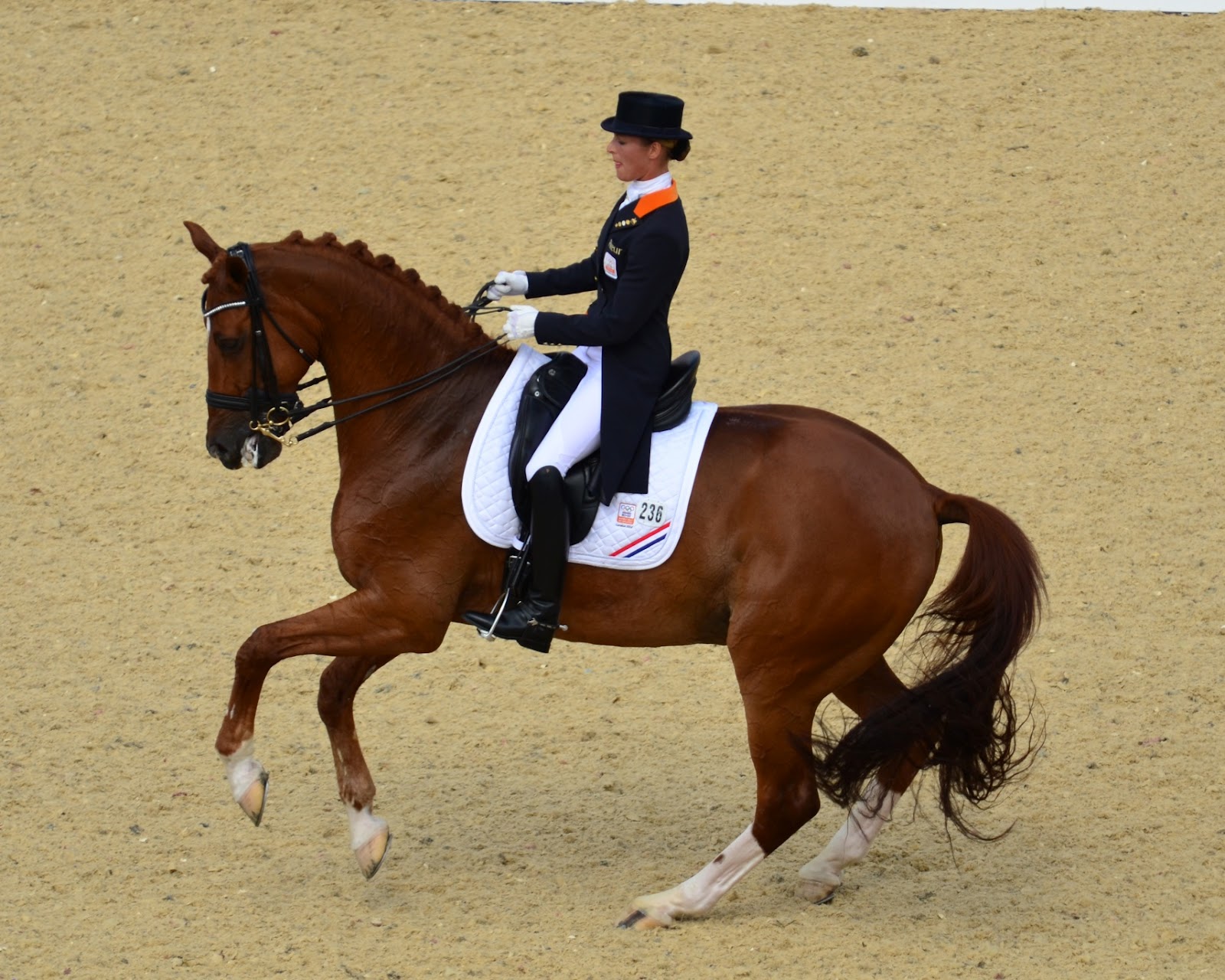
A final salute to the 2012 Olympics: Adrienne Lyle and Wizard of Team USA. Photo by Jennifer Bryant.

If an Olympic Games and a Paralympic Games are as wonderful as the ones in London 2012, their conclusion brings a bit of wistful sadness. It's hard to see something so special come to an end.

As joyous as the performances and as thrilling as Great Britain's hard-earned victories were, many US dressage fans are feeling more down in the dumps than usual. After having won team bronze from 1992 to 2004, we'd become accustomed to our status as dressage medalists. But London was the second Olympics in a row to leave the American dressage team off the podium.

Depending on whom you ask, the medal-less status is anything from a nonissue to a crisis. Some argue, reasonably, that any horse and rider can have an off day, and that failure to medal in such exalted company is no reason to hang one's head in shame. After all, those in London had made it to the Olympics -- no easy feat!

Others perceive that, at the high-performance level, as it's called, competition is a big-stakes affair. Medals, and the promise of more medals to come, help lure donors and sponsors. Or to put it more bluntly, people tend to back a winning team but few want to back a loser. To further complicate matters, by not medaling, a nation must qualify to participate in a future Olympics, meaning that we need to fight to get in the game for Rio 2016.

The question that many are asking is: Why did the US not medal, and what can we do about it?

The consensus seems to be that, although American riders are top-notch, our crop of horses, at least at the time of the London Games, was outclassed, eclipsed by a new breed of superhorses (Exhibit A: Valegro). So the solution to the problem would seem to be: Buy Valegro or horses of his quality, or breed a Valegro or horses of that quality.

In the months and years to come, we shall see whether our rising stars -- Wizard, Paragon, Legolas, Pikko del Cerro HU, and others -- are of that caliber. And I have a feeling that sales of top dressage horses will engender even more scrutiny than in the past, now that we see how assembling a dressage dream team of horseflesh vaulted Team GB from pretty much nowhere to Olympic gold in a short four years or so.

Great Britain's lottery helped to fund its equestrian teams. In the US, we depend largely on the largesse of private sponsor/owners. But presumably even wealthy patrons don't have unlimited resources. Can American dressage find the necessary funding? Should doing so be the priority of those who govern our sport? These are not easy questions to answer. The only thing I'm willing to bank on at this point is that these issues will receive a lot of attention and debate over the next four years.

Wednesday, September 5, 2012

Great Britain, Already Olympic Dressage Team Gold Medalists, Scores More Gold at Paralympic Games

The 2012 Paralympic Games equestrian team medalists (from left): Germany (silver), Great Britain (gold), and Ireland (bronze). Photo by FEI/Liz Gregg.
Team Great Britain was unstoppable at the 2012 London Olympic Games dressage competition, and our friends and rivals from across the pond did it again at the 2012 London Paralympic Games.

The British Paralympic equestrian team (Lee Pearson/Gentleman, Grade Ib; Sophie Wells/Pinocchio, Grade IV; Deborah Criddle/LJT Akilles, Grade III, and Sophie Christiansen/Janeiro 6, Grade Ia) claimed gold with a total score of 468.817.

Paralympic equestrian team silver went to Germany, with a team total of 440.970: Angelika Trabert/Ariva-Avanti, Grade II; Britta Napel/Aquilina 3, Grade II; Steffen Zeibig/Waldemar, Grade III; and Hannelore Brenner/Women of the World, Grade III.

The team bronze medal, with a total score of 428.313, went to Ireland: Eilish Byrne/Youri, Grade II; James Dwyer/Orlando, Grade IV; Geraldine Savage/Blues Tip Top Too, Grade Ia; and Helen Kearney/Mister Cool, Grade Ia.

Team USA (Dale Dedrick/Bonifatius, Grade II; Rebecca Hart/Lord Ludger, Grade II; Jonathan Wentz/Richter Scale, Grade Ib; and Donna Ponessa/Western Rose, Grade Ia) finished seventh with a total score of 417.528.
Team USA's Jonathan Wentz and Richter Scale on their way to fourth place in the Grade Ib Individual Championship test. Photo by Lindsay Yosay McCall.
Wentz, 21, of Richardson, TX, had the best individual placing of any American equestrian at the Paralympics: fourth in the Grade Ib Individual Championship test with a score of 70.348 percent. The gold medal went to Australia's Joann Formosa on Worldwide PB (75.826). Great Britain's Lee Pearson on Gentleman, so accustomed to Paralympic gold medals, had to settle for silver this time with 75.391. Austria's Pepo Puch on Fine Feeling won bronze with 75.043.

US Paralympian Rebecca Hart also made a strong showing in London, with a fifth-placed finish in the Grade II Freestyle on a score of 73.250 percent. It was an impressive rally after a somewhat disappointing eleventh place in the Grade II Individual test on 68.286.

Hart's Grade II teammate, Dale Dedrick on Bonifatius, was tenth in the Grade II FS with 69.150.

As in the Olympic dressage competition, Team GB also dominated the individual dressage medals. The big winner was Grade Ia rider Sophie Christiansen, who won gold in the Grade Ia Individual and Freestyle in addition to her team gold. Christiansen was the only equestrian athlete to score three gold medals at these Paralympic Games.
Natasha Baker of Great Britain exults after her record-breaking score and gold medal in the Grade II Freestyle. Photo by Lindsay Yosay McCall. 
Another British rider, Natasha Baker, made headlines of her own for toppling the Paralympic record in the Grade II Freestyle. Aboard Cabral, Baker broke the 80-percent mark, earning a score of 82.800 to win the gold medal. Baker also took gold in the Grade II Individual championship test, with a score of 76.857.

Congratulations to all the Paralympic equestrians and their horses, coaches, horse owners, and supporters!


Monday, August 13, 2012

It's Not over Yet!

I'm suffering from Olympic withdrawal today.

Last night, I watched as much of the taped NBC coverage of the closing ceremonies as I could before the jet lag caught up with me. I drank in all of the highlight reels, feel-good-story recaps, and other coverage of the past two weeks--because, crazy busy as I was with Olympic equestrian coverage, I'd missed it all.
The Tower of London provided a striking backdrop for the Olympic rings in the Thames. Photo courtesy of the International Olympic Committee.
By most accounts, the 2012 London Olympic Games were a smashing success. The events were well run and the venues were well received by athletes and officials alike. The city, endlessly fascinating in its own right, proved a striking backdrop and a photographer's delight. The normally reserved British people threw themselves into the Olympic spirit, welcoming visitors and appearing to thoroughly enjoy themselves and the spotlight on London. The royal family participated. British rock stars participated. Even Mother Nature cooperated, giving London a nearly complete respite from the torrential rains that had plagued the city earlier in the summer.

The Olympic equestrian events were positively history-making. Great Britain won team gold in jumping and then claimed both the team and the individual dressage gold medals, a first in Olympic history. The largely British crowds at Greenwich Park went mad with joy; I think they did the wave at least ten times around the entire stadium after Charlotte Dujardin on Valegro won the individual dressage gold. And Dujardin's 90-plus Grand Prix Freestyle score set an Olympic record, causing even more pandemonium.

Residing as I do in a country that is lukewarm at best to equestrian sports, it was really fun to see hordes of spectators crowding around individual dressage medalists Dujardin, Adelinde Cornelissen, and Laura Bechtolsheimer, following the three women en masse as they made their way from the medal ceremony to the press-conference room. In this world, for this moment, dressage riders were superstars, with photos being snapped like mad, and tickets and pens being outthrust with requests for autographs.

London was fab...the Olympics were fab...the only thing that wasn't fab was that our wonderful event, jumper, and dressage riders couldn't seem to catch a break at these Games. It was the first time since Stockholm 1956 that the USA won no Olympic equestrian medals at all. Ouch. We equestrian enthusiasts get to know (or feel as if we know) our sports' top performers. We know how hard they work and how talented their horses are, and we feel for them when they try so hard for the brass ring and miss. But we also know that you don't get to the top without mental toughness, and we know our riders will be right back out there fighting in just two years' time, at the 2014 Alltech FEI World Equestrian Games in Normandy, France.

So if the end of the Olympics and the lack of big celebrations for Team USA have you feeling down, chin up! as the Brits might say. The 2012 London Paralympic Games are just over two weeks away. The US Paralympic dressage team looks to be very strong, and we'll be bringing you news and photos from London once again. And if ever you needed something to boost your spirits, the sight of an otherwise physically disabled rider dancing with a beautiful dressage horse is sure to bring a smile to your face.

Meanwhile, if you can't get enough from the London Olympics and you're a United States Dressage Federation member, you're in luck. We'll be featuring more great photos in the November issue of USDF Connection, the USDF member magazine. Best of all, I'll be bringing you my exclusive interview with British FEI 4* judge Stephen Clarke, a member of the 2012 Olympic dressage ground jury. Mr. Clarke is a soft-spoken British gentleman of the first order--but he doesn't tiptoe around his opinions. Don't miss it.

Cheerio from London, and good luck to our Paralympians!

Thursday, August 9, 2012

A New Dressage World Order

Charlotte Dujardin and Valegro of Great Britain on their way to victory in the Grand Prix Freestyle and individual Olympic gold. Photo by Jennifer Bryant.
The Germans have been toppled off the dressage pedestal. The Dutch have lost their grip on the top spot. There's nary a Dane nor a Swede to be seen. What has dressage come to?

What it's come to is a complete erasure of the conventional wisdom about which nations do and do not belong on the dressage world stage. If there was any doubt about Great Britain's dominance after it won 2012 Olympic team gold on August 7, those doubts were wiped away when two British team members stepped back on the podium today to claim individual Olympic dressage gold and bronze.

The 26-year-old phenomenon Charlotte Dujardin rode Valegro to a movie-soundtrack medley including The Great Escape and Live and Let Die, which segued into canter pirouettes to the bonging of Big Ben, extended canter to "Pomp and Circumstance," and passage to John Williams's "Summon the Heroes," better known as the Olympic theme we hear on TV. Together the musical selections made for an enjoyable freestyle; my main quibble would be over some choppy edits and musical transitions.
British fans go wild after Charlotte Dujardin's score of 90.089 went up on the board. Photo by Jennifer Bryant.
"With the Olympics being in London, I wanted something special," Dujardin said of the freestyle. She described being "totally unprepared" to do a freestyle until she rode a Grand Prix Special test at the 2012 CDI Hagen (Germany) to which organizers used The Great Escape as background music. "I thought it was brilliant, and I thought that's what I'm going to do: I'm going to have a British theme. I went back to Tom Hunt, the composer, and I said I want a British theme, and I want Big Ben, and I want all the other stuff. And he was like, 'I'm not sure if I can do that.' And I was like, you can, and he did, and he produced an amazing freestyle, and it's really, really great to ride to."

The musical selections suited the ten-year-old Dutch Warmblood gelding (by Negro), who executed a technically outstanding test marred only by a bobbled transition from an extended canter down center line to passage at D. Judges Stephen Clarke (C), Leif Tornblad (K), Wim Ernes (E), Jean-Michel Roudier (H), Maribel Alonso (M), Evi Eisenhardt (B), and Gary Rockwell (F) awarded Dujardin's effort a technical average score of 86.750 percent and an artistic average score of 93.429 percent for a combined average of 90.089 percent--an Olympic Games record.

"It's unbelievable," said an emotional Dujardin afterward. "[Valegro] felt tired, but he still gave me everything. I can't believe it was only last January that we did our first Grand Prix, and now we have two Olympic gold medals."
Individual silver medalists Adelinde Cornelissen and Parzival of the Netherlands. Photo by Jennifer Bryant.
Finishing a close second for the individual silver medal was the Netherlands' Adelinde Cornelissen on Parzival. Showing great musicality to pleasantly amped-up versions of The Nutcracker Suite, the Dutch pair earned marks of 92.286 (artistic) and 84.107 (technical) for a total score of 88.196 percent.

Parzival's piaffe to the "Dance of the Sugar Plum Fairy" was a highlight of Cornelissen's freestyle, as was his extended canter to the "Russian Dance." The routine featured numerous double pirouettes, clearly one of Parzival's strong suits. The fifteen-year-old Dutch Warmblood gelding (by Jazz) was short in the neck at times in the extended trot, and later piaffes started to get a bit croup-high.

Stephen Clarke, who served as president of the ground jury today, said of the rides: "I think the first two horses were very close. The impression we had was that Adelinde had huge power and expression, but for us there needed to be a little more lightness and self-carriage. You could see sometimes that the horse crosses his jaw a little bit, so that took down the harmony mark a touch.

"Charlotte's [horse] generally has a little more self-carriage but maybe not quite as much power and expression in some of the piaffe-passage," Clarke continued. "So they were very close together. I'm sure lots of people will have different opinions, but our decision was for the harmony."

Of her ride, Cornelissen said: "Parzival felt great. I think it has been one of his best tests ever. I gave it all."
Great Britain's Laura Bechtolsheimer exults after her bronze-medal-winning ride aboard Mistral Hojris. Photo by Jennifer Bryant.
Dujardin's gold-medal teammate Laura Bechtolsheimer and her longtime partner, Mistral Hojris, had a lovely interpretation of music from The Lion King. "Alf's" movement harmonized well with the music, including a passage half-pass to a piaffe pirouette that was right on the beat, and a piaffe-passage tour that showed great musical interpretation. Alf's movement looked a bit flatter than in the Grand Prix Special, but Bechtolsheimer was exuberant at the conclusion of her performance, which earned a technical score of 80.679 and an artistic score of 88.000 for a combined total of 84.339 percent and the individual bronze medal.

"Today I wanted to do him justice," Bechtolsheimer said, referring to the little mistakes of her previous tests at the 2012 Olympic Games. "I wanted to go out and enjoy the atmosphere and enjoy riding to an awesome freestyle in front of so many spectators and fans. He rose to the occasion. He gave me a very special ride. I felt like finally I'd done him justice."
Anky van Grunsven thanks Salinero for a job well done. Photo by Jennifer Bryant.
The previous Olympic individual champion, the Netherlands' Anky van Grunsven on Salinero, ended the eighteen-year-old Hanoverian gelding's (by Salieri) competitive career on a high note. Salinero gave his best performance of these Olympics, and in fact it's the best I've ever seen him look. He showed greater softness over his topline and relaxation to a French-themed medley that showcased van Grunsven's famous freestyle artistry. The freestyle was so good that I wouldn't have been surprised if she had medaled. The ride scored 77.714 (technical) and 86.286 (artistic) for a combined score of 82.000--and I actually thought it might have deserved a tick higher.

"I am not sad. It has been an emotional week, but it was always in my head that it was my last time, and I wanted to enjoy it," van Grunsven said afterward.
You can tell everything you need to know about how Steffen Peters felt about his GP Freestyle on Ravel by the expression on his face. Photo by Jennifer Bryant.
The other emotional ride of the day, unfortunately not in a good way, was that of the lone American rider to qualify for the Grand Prix Freestyle. Steffen Peters and Ravel's ride to music from the movie Avatar was artistically compelling but riddled with minor mistakes. Supporters, including Peters' wife, Shannon, teared up watching the ride, which Peters acknowledged afterward was indeed Ravel's competitive swan song.

"We did a super warm-up," Peters said of the freestyle. "We can't blame the heat; we are used to that, and I had plenty of horse. There were just too many mistakes. That is it for Ravel. He is retiring now to his owner's [Akiko Yamazaki] stud in California. I will remember him for his great career. If you put it all together, today was only a glitch. He has given us so much, and it is so sad, but it was not quite happening today."

Endings are always a little sad. The 2012 London Olympic Games have been a thrilling and memorable experience. The organizers did a superb job, and the Greenwich Park venue received accolades from every rider, veterinarian, and official I talked to. Over the past fourteen days we've seen outstanding displays of horsemanship, and we've seen the sport of dressage lifted to new standards. I will go home with memories of the friendly and welcoming staffers and volunteers and the hospitable locals, who seemed to enjoy sharing Greenwich and London with us. But I will also go home feeling sad for the American riders and their wonderful horses, owners, and supporters who worked so hard and yet will go home empty-handed.

Medals aren't everything, but at this level they are of course what competitors are striving for. Teams and individuals want to bring home medals to make their nations and their supporters proud. I know that Steffen Peters in particular is having a bittersweet evening, for this is not how he wanted to end Ravel's career. But I think I speak for the American dressage community when I say that we are proud, we appreciate Ravel's incredible legacy to US dressage, and we look forward to seeing Steffen doing great things in the future. He is a great rider and a great horseman, and his own legacy, although secure, is far from over.


Wednesday, August 8, 2012

Grand Prix Freestyle Order of Go

Tomorrow, August 9, is the finale of the 2012 London Olympic Games equestrian competition: the Grand Prix Freestyle, which is the individual dressage medal final.

The top 18 horses and riders from the Grand Prix and the GP Special qualified to contest the Freestyle, which commences at 12:30 p.m. London time. Of the US riders, only Steffen Peters and Ravel have made the cut.

The Freestyle will decide the individual medals. Scores from the GP and the Special served as qualifiers only for individual-medal purposes and will not count toward final totals.

Judging by the quality we've seen this week, you're not going to want to miss the Freestyle. Set those alarms and get up early. Here is the complete order of go.

12:30 Valentina Truppa/Eremo del Castegno (ITA)
12:40 Patrick Kittel/Scandic (SWE)
12:50 Anna Kasprzak/Donnperignon (DEN)
1:00 Goncalo Carvalho/Rubi (POR)
1:10 Victoria Max-Theurer/Augustin (AUT)
1:20 Tinne Vilhelmson-Silfven/Don Auriello (SWE)

1:45 Steffen Peters/Ravel (USA)
1:55 Edward Gal/Undercover (NED)
2:05 Nathalie zu Sayn-Wittgenstein/Digby (DEN)
2:15 Anky van Grunsven/Salinero (NED)
2:25 Juan Manuel Munoz Diaz/Fuego (ESP)
2:35 Kristina Sprehe/Desperados (GER)

3:00 Helen Langehanenberg/Damon Hill (GER)
3:10 Dorothee Schneider/Diva Royal (GER)
3:20 Laura Bechtolsheimer/Mistral Hojris (GBR)
3:30 Carl Hester/Uthopia (GBR)
3:40 Adelinde Cornelissen/Parzival (NED)
3:50 Charlotte Dujardin/Valegro (GBR)

And the ground jury:
K: Leif Tornblad (DEN)
E: Wim Ernes (NED)
H: Jean-Michel Roudier (FRA)
C: Stephen Clarke (GBR) (president)
M: Maribel Alonso (MEX)
B: Evi Eisenhardt (GER)
F: Gary Rockwell (USA)


I Guess Orange Looks a Lot Like Red

Photo of the dressage misprints from HorseandHound.co.uk

London's Daily Mirror and Daily Express both published front-page photos of the bronze-medal-winning Dutch Olympic dressage team today instead of the team they intended: the gold-medal-winning British dressage team, of course.

The Express reportedly reprinted its front page, but not before it aroused the ire of the British Equestrian Federation and drew criticism from the well-known British equestrian magazine Horse & Hound, among others.

Sunday, August 5, 2012

A Collection of Londonisms

Between the jumping and the dressage team and individual medal finals, the next few days are going to be some of the busiest yet for us journalists in Greenwich Park. Before medal madness sets in, I thought I'd take a few moments of relatively quiet time to share some random observations gleaned from my time in London thus far.
A patriotic chap in the Olympic cross-country warm-up area.
Brits love their country. Americans like to think of themselves as the most fiercely patriotic, but the Brits could give us a run for our money. Everywhere I go, I see Union Jacks--hung from windows, draped over shoulders, on hats, on shirts, on dogs, painted on faces and fingernails. A woman on the Docklands Light Railway train en route to the Olympic stadium today was resplendent in a British-flag jacket and skin-tight white leggings covered with the Union Jack pattern.

Brits are polite. A pleasant greeting and liberal use of "please" and "thank you" score points. One day in the equestrian press workroom, an American journalist (not me!) demanded (not asked) that an announcement be repeated. I later overheard the press officer complaining about the "stroppy American."

The British also are famous for being generally orderly and rules-abiding--think queuing and things of that sort. They wait patiently until passengers have exited a train before embarking. Not all cultures do this, which makes for some culture clashes at the stations filled with Olympics-goers. I was standing behind an elderly British couple trying to disembark a train today. When people on the platform pushed past them to get on, the wife sniffed, "Manners...nonexistent."

It rains every day, usually around midday, even if the morning and afternoon are lovely and sunny. And by "rain" I mean "torrential downpour," usually accompanied by a frightful wind that will ensure that no umbrella or raincoat will keep you totally dry. It also frequently rains during the night.
Cross-country day was 68 degrees F - perfect for sunbathing in London!
When Londoners describe the weather as "hot," they mean "over 70 degrees F."

Streets and public spaces are clean. Perhaps some of it is Olympic put-your-best-foot-forward zeal, but seriously, I've seen no graffiti. No dog poop. No litter. Despite the fact that the Greenwich Tavern, situated just outside the venue gates, is mobbed with people every afternoon (especially the Dutch, clad as always in orange) who spill into the street with their pints and their clouds of cigarette smoke, I have yet to see broken glass or a butt on the ground. This morning I ventured through the Greenwich Foot Tunnel, a 1,217-foot-long pedestrian tunnel beneath the Thames that connects Greenwich to Canary Wharf. The entire tunnel is lined with white glazed tiles, with nary a mark on them.

The British may be reserved and stiff-upper-lip and all that, but get a few pints into them and that changes. They are just as sappy and sentimental about their horses as we are. They also feel that way about the royal family. As one equestrian official put it, "We'll complain about the monarchy and the expense, but we'll defend them until the last breath in our bodies."
I didn't frequent this establishment until I learned you can get pie without the eels. 
Potato chips are crisps, and they're all advertised as being made with "British potatoes" (as opposed to Irish potatoes?). Mash is mashed potatoes. Liquor is a gravy made with minced parsley (no booze) traditionally spooned over pie (minced-beef pot pie; no, I didn't go for the equally traditional version containing eels). French fries are chips. Bangers are sausages. Ice cream is served in a tub, not a cup. You order food to take away, not to go or for takeout.

Crisps come in interesting flavors, such as Cajun prawn and curry.

The first floor is the ground floor, and the second floor is the first floor.

The sign on the door of the dorm I'm staying in reads, "Turn key anti-clockwise." Makes it sound as if they're opposed to the idea of going clockwise.

The fact that people here drive on the left side of the road means that you have to look left before crossing the street. Despite the fact that nearly every crossing is emblazoned with LOOK LEFT in big white letters, a certain jet-lagged reporter nearly got run over by a double-decker bus her first day in London.

Those double-decker buses are everywhere--they're just regular city buses. So are bobbies (police officers) in those tall black bobby hats and nightsticks, and red phone booths (again, no damage, no defacing), and cool-looking taxis, the traditional black ones and some sporting wild patterns and logos.
Some typical London vehicles
Automobiles are small. There is nothing resembling a pickup truck in any way. I have spotted exactly one Honda CR-V and a couple of Range Rovers, and that's it for SUVs. Everybody drives smallish hatchbacks or sedans. Some of them are really cute. I've seen a few Mercedes models that bear a strong resemblance to my Honda Fit.

When people aren't driving (which seems to be often), they walk or ride bicycles, or they take public transit.

"Mate" means "dude" in a cordial sort of way, as best I can figure out. Speaking of cordiality, everybody ends conversations, both in person and over the phone, with "Cheers." Of course, with the accent it sounds like "Chizz" to my American ear, so maybe they're not really saying "cheers" at all. But I'd like to think that's what they're saying; it sounds so upbeat, and also as if cocktail hour were right around the corner.

Cheers!


Saturday, August 4, 2012

Quick Change: From College Grad to Olympic Dressage Groom

Team USA 2012 Olympic dressage horse Calecto V and his groom, Lauren Donahoo. Photo courtesy of Lauren Donahoo.
Lauren Donahoo's life was falling into place.

A 2011 graduate of William Woods University in Fulton, MO, Donahoo had earned a bachelor's degree in equine science and had been accepted into WWU's graduate-assistant program, where she intended to pursue a master's degree in marketing. She was also engaged to be married, with a July 21, 2012 wedding planned.

So in October 2011, when she saw the Facebook post advertising the opening for a dressage groom, Donahoo ignored it.

A month later, the Facebook poster, Grand Prix-level rider and then-Olympic hopeful Tina Konyot, posted her ad again.

Donahoo, 23, of Dallas, TX, was a Facebook fan of Konyot's. She had hands-on horse experience, of course, but her equestrian resume was modest: She'd shown through Fourth Level and had never done  the FEI Juniors or Young Riders.

"I'd done regular shows, groomed multiple horses, ridden and shown multiple horses at shows, but I'd never done a CDI" (an FEI-recognized dressage competition), Donahoo says.

She answered the ad.

Something about it drew Donahoo--probably the part about "education, adventure, and a shot at making the Olympic team" and going to the London 2012 Games as the groom of a Team USA horse. And something about the young woman's dedication, work ethic, and willingness to take a chance obviously spoke to Konyot.

"Tina called in late November 2011," Donahoo says. "I came out for two and a half days" to interview for the position, "and two weeks later I started as her groom. I left the university, moved to Florida [Konyot's winter base], and started working December 31, 2011."

Donahoo and her fiancé, Jonathan Keeton, who lives in Missouri, had several heart-to-hearts before she decided to embark on the adventure. They agreed to postpone the wedding until November 23, although she's been a little too busy lately to give things like flowers and invitations much thought.

As Konyot's groom, Donahoo is responsible for the care, grooming, tack, feeding, and everything else pertaining to the Danish stallion Calecto V. Konyot wasted no time indoctrinating her new groom into the world of high-performance dressage: A short time after Donahoo started, they were off to a CDI. And another, and another--the entire chain of qualifying events leading up to the US Olympic dressage selection trials at Gladstone, NJ, in June. A few weeks after that, Donahoo and her charge were headed to London.

Being the groom for an international-level dressage horse and rider is hard work: Donahoo says she regularly puts in ten- to fifteen-hour days.

"My last full day off, away from the horses entirely, was in March," she says.

And the "education" part Konyot promised in her ad? Donahoo has learned that grooming at this level is show grooming, but "super-fine-tuned. It's the specifics of making one person and one horse going into the show ring absolutely perfect. The horsemanship is off the charts."

All the details, from the scheduling of Calecto's farrier and other caretaker appointments to the execution of every braid on his handsomely crested neck, fall to Donahoo. She fretted when she was not permitted to fly with him to London (not enough room) and is overjoyed that she will be able to escort her charge back to his summer home near Toronto when the Olympics are over.

As much as Donahoo has benefited from the experience--"I was at the training camp [in England] with the top six dressage horses in the US. You can't get that kind of opportunity anywhere else"--she admits to missing home, fiancé, and riding. (She hasn't ridden since she started working for Konyot, and she hasn't seen Keeton since March.) Although Konyot has "offered me a job for as long as I want," Donahoo hasn't made up her mind.

"It's hard to be out of the saddle," she admits, adding that she hopes one day to be in Konyot's place at an Olympic Games.

Still, it's been an adventure like no other, and Donahoo is thoroughly in love with the big bay stallion, who snuggles with her in his stall at home as well as in London. She still can't quite believe she's in London with an Olympic horse at the Olympic Games: a bit star-struck, she recounts her first time "walking out the main arena [at Greenwich Park], and there are Mistral and Valegro."

But at the same time, Donahoo recognizes that she seized the opportunity and has made the most of it.

"Don't be afraid to step outside the comfort zone," Donahoo advises other aspiring dressage professionals.

Oh, and before that wedding finally rolls around, Donahoo will have one more task to attend to: dress alterations.

"I've dropped, like, five dress sizes," she says.


Friday, August 3, 2012

Team USA Dressage Will Advance to the Grand Prix Special

Ravel's passage earned some of the highest marks for Steffen Peters and the US dressage team. Photo by Jennifer Bryant.
Steffen Peters' overall average Grand Prix score of 77.705 percent aboard Ravel boosted the American team's Grand Prix average to 72.801 percent, good enough for fifth place in the team standings.

The top seven teams advance to the Olympic Grand Prix Special; so Team USA will go forward to vie for an Olympic team dressage medal on Tuesday, August 7.

In the supple, relaxed, expressive style that we've come to expect from Ravel, the fourteen-year-old KWPN gelding (by Contango) put in an excellent Grand Prix test that earned raves from Peters.


"I am so excited. Ravel felt as supple as he has ever done. There were so many highlights that I can't wait for the next three days. I looked at Carl Hester's test [aboard Uthopia yesterday] and thought I might be similar, so my score is a thrill," Peters said afterward.


Peters was right: His 77.705 is just 0.15 percent behind Hester's 77.720. Hester currently lies in fifth place individually, and Peters lies sixth.


Leading the pack and helping to propel Great Britain to the top spot in the team standings is Charlotte Dujardin and Valegro, a ten-year-old KWPN gelding by Negro. Their score of 83.663 percent topped that of the Netherlands' Adelinde Cornelissen and the 1997 KWPN gelding Parzival (Jazz), who are second in the individual standings with 81.687 percent. Helen Langehanenberg and the 1999 Westfalen stallion Damon Hill (Donnerhall) of Germany are ranked third with 81.140 percent, and German teammate Kristina Sprehe on the 2000 Hanoverian stallion Desperados (De Niro) stand fourth with 79.119.
A "10" extended trot: Great Britain's Valegro and Charlotte Dujardin. Photo by Jennifer Bryant.


The seven-judge panel (Gary Rockwell of the USA at C, Leif Tornblad of Denmark at H, Stephen Clarke of Great Britain at M, Maribel Alonso of Mexico at B, Evi Eisenhardt of Germany at F, Wim Ernes of the Netherlands at K, and Jean-Michel Roudier of France at E) awarded Dujardin and Valegro particularly high marks for their extended trot and their two-tempi changes. The two-tempis earned four scores of 10, and their second extended trot earned three 10s. In the collective marks, Dujardin received two 10s for "rider's position and seat; correctness and effect of the aids."


Dujardin called Valegro's score, which set a new Olympic Grand Prix record, "unbelievable. I wanted to come here and have fun. I wanted to go out and show what this horse can do. It is a once-in-a lifetime-opportunity."


As the judges saw it, Parzival's highlights were his piaffe (one 10) and his passage and piaffe-passage transitions (several scores of 9.5). Cornelissen received one 10 for the "rider" collective mark.


There were no marks of 10 for Peters and Ravel. Ravel got some 9s for his extended canter, canter pirouettes, and passage; but he also earned across-the-board scores of 5 for movement 25, the flying change at X between the two pirouettes, which appeared to be late behind.


The first to go today, the USA's Tina Konyot on her Danish Warmblood stallion Calecto V (by Come Back II), put in a solid and fluent test with a few minor bobbles to score 70.456 percent. They are currently twenty-seventh individually.
Tina Konyot embraces Calecto V after their Grand Prix test. Photo by Jennifer Bryant.
"I missed a couple of my extensions in there, but overall I was very happy with my test," Konyot said. "It's just a great feeling to be here."


Despite the fact that the audience wasn't yet quite settled by the time Konyot entered the arena, the rider claimed it wasn't a distraction.


"I'm in my own zone," she said. "Someone could streak across the arena and I wouldn't notice them--well, it depends on who it is," she added.


US individual competitor Adrienne Lyle kept the occasionally explosive Wizard mostly focused and relaxed to produce a promising test that earned a score of 69.468 percent, putting them thirty-fifth in the individual standings.
Adrienne Lyle and Wizard in a lovely canter pirouette. Photo by Jennifer Bryant.


"Wizard was very amped up and on the edge, so we were trying to hold it together so he didn't get too flustered," Lyle said afterward. "He had a few mistakes just due to tension [including a break to canter during an extended trot], but I was happy."


Lyle said the 1999 Oldenburg gelding (by Weltmeyer) was pretty excited just before the pair's entrance into the Olympic equestrian stadium.


"We weren't even able to walk into the ring," she said. "We were kind of doing whirlybirds."


Lyle is thoroughly enjoying her first Olympic experience. "It was very cool going down center line, for sure!" she said. 


US team pair Jan Ebeling and Rafalca, who competed yesterday, are in thirtieth place individually with their Grand Prix score of 70.243 percent.


Besides Great Britain, Germany, and the USA, the other teams that will advance to the Grand Prix Special (the team medal final) are the Netherlands (3), Denmark (4), Spain (6), and Sweden (7). 


It will be exciting to see what the competition ahead brings. The bar has already been set in the low 80s; and later scores, especially those in the Grand Prix Freestyle, typically rise significantly. I wouldn't be surprised if we see some scores of 90-plus in the days to come.

Thursday, August 2, 2012

Ebeling and Rafalca Get US Dressage off to a Strong Start

Jan Ebeling and Rafalca in the Grand Prix for Team USA. Photo by Jennifer Bryant.
Jan Ebeling said he was "very happy" with his "good ride" on Rafalca in the Grand Prix at the 2012 London Olympic Games today.

Ebeling was the eighth to ride today and the first to go for the US dressage team. The fifteen-year-old Oldenburg mare (by Argentinius) put in a steady and accurate test with just a few moments of loss of balance or a slight loss of thrust from her right hind leg to earn a score of 70.243 percent.

"I think my second pirouette started out a little bit large; she jumped off the line a bit. But overall it was great. My piaffes were really nice, and that's something that's really improved over the last couple of months. I think the frame was good: She was up, and she felt really good. She's fit, and I think she's peaking just at the right moment," Ebeling said afterward.

Other than eventing's Zara Phillips, whose royal connections enthralled the mainstream media, Ebeling is probably drawing the most mainstream-media attention focused on an equestrian at these Olympic Games. The reason, of course, is Ann Romney's part-ownership of Rafalca, which was unremarkable before her husband, Mitt Romney, decided to run for the US presidency. So Ebeling fielded the expected questions from Bloomberg News and the like about Mrs. Romney and about how he's dealing with the spotlight.

"It really ended up being a good thing for the sport," Ebeling said. "I don't really get distracted by these things. I have a pretty good way of focusing. And if I don't want to talk to anybody, I don't answer my phone!"

And yes, Anne Gribbons, Ebeling's first halt looked pretty good. (He said the coach has been on him to improve that movement.) But he admitted to almost saluting with the other hand than the one he normally uses--his one admission of nervousness.

Ebeling had to explain to the mainstream media present what "amped up" means in terms of how Rafalca felt today. It's a good thing, in case you were wondering, but "the trick is to manage it," he said.

Ebeling's good showing gets Team USA off to a solid start. Fellow team members Steffen Peters/Ravel and Tina Konyot/Calecto V go tomorrow (Tina first of the day at 11:00 and Steffen at 2:35). Adrienne Lyle/Wizard, riding as individuals, go at 12:51.

But Team GB has definitely issued the challenge, with two of its riders earning today's top scores. Carl Hester on the 2001 KWPN stallion Uthopia (by Metall) holds the lead with a score of 77.720 percent. The dark-bay stallion put in a Grand Prix test with great suppleness, relaxation, elegance, and scope.
Great Britain's Carl Hester and Uthopia lead the GP standings with 77.720 percent. Photo by Jennifer Bryant.

Close behind Hester is teammate Laura Bechtolsheimer on the 1995 Dutch Warmblood gelding Mistral Hojris (by Michellino). The 2010 Alltech FEI World Equestrian Games individual silver medalist earned a score of 76.839 percent for a test that had plenty of expression but a couple of mistakes: an early change after the extended canter and a mistake in the two-tempi changes. "Alf" looked a bit "on the muscle," and although he didn't appear resistant or stiff, Bechtolsheimer appeared to be working pretty hard, with a decent amount of weight in the reins.

Team Canada, unfortunately, is left licking its wounds after David Marcus on Capital was eliminated after the horse had a meltdown in the middle of the sudden drenching downpour that came as quickly as it went. With teams of three and no drop score, Marcus's failure to finish knocks Canada out of the team competition. Ashley Holzer, who rides Breaking Dawn tomorrow, therefore will ride only for the individual-medal qualifier and not for a Canadian team medal.

Team USA: Relaxed and Ready to Go

Jan Ebeling, Tina Konyot, Adrienne Lyle, and Steffen Peters were all smiles at the pre-competition press conference. Photo by Jennifer Bryant.
"Fun" isn't always a word associated with a press conference, but that's the word journalists were using to describe yesterday's pre-competition meeting with the 2012 US Olympic dressage team.

"That rider, Tina, she's a hoot," said one foreign journalist, referring to Tina Konyot's frank admission that she eschews regimented exercise programs in favor of "retail therapy," as she called it.

"'Oh, honey, don't do anything different,'" Konyot said her boyfriend told her after learning that there was a fitness program at the riders' training camp in England. "'Just go shopping.'"

The four riders appeared relaxed and to genuinely enjoy one another's company. Konyot would rib Peters, who would rib Konyot right back. (Asked if Peters, the Olympic veteran, was helping to keep the others' nerves at bay, Konyot quipped: "He's trying to keep me from getting any looser than I already am.")

 Jan Ebeling, seemingly unfazed by the mainstream-media spotlight trained on him thanks to Ann Romney's part-ownership of his Olympic horse, Rafalca, said he's welcomed the attention and has been trying to use it to raise awareness of the sport of dressage--that it's not just "riders trotting in circles," as he put it. Even Lyle, the youngest member of Team USA and the newest to the international scene, seemed at ease.

One can assume that the competitors wouldn't be this relaxed if they felt shaky about their upcoming performances, which begin today with the team and individual Grand Prix. And indeed all expressed confidence that their horses are going well--Konyot said Calecto V is the best he's ever been--and that their careful preparation and that of US national dressage high-performance coach Anne Gribbons has the horses peaking just at the right time.


"We showed at Aachen last year, then showed at the selection trials on the West Coast," Peters said of his mount, Ravel, "We did the World Dressage Masters in January, but I didn’t believe that the horse could stay in top shape for eight months, so he had a little break in April and May. Since then he's been great. We picked up the training a little more since he arrived in Gladstone, right after the championships. I have a very fresh horse. Today I did an extended canter and he was bucking a little bit. That's the Ravel that I had for the World Cup in 2007. That's the Ravel I had before Aachen in 2009. I'm excited that he feels this way, and I can't wait to go down center line."

The US has definitely created an "American way" of dressage, and Peters expressed pride in our reputation for horsemanship.

"We got so many wonderful compliments when we trained with [previous US national dressage coach] Klaus Balkenhol, that the American team is known for true kindness to the horse, and it's [training] always done with the most respect. To me, being competitive and on top of that hearing those compliments means the world to me."

It didn't take much prodding to get the riders to open up about their horses. Ebeling said of Rafalca: "She comes out every day and tries her best. That's what I love about her. I feel she's a horse that I can really depend on, and the effect she has on me is she makes me very calm. Of course there's a lot of pressure--this is the biggest horse show in the world--but she makes me feel, Hey, I can relax."

"He has a magnificent, sweet character," Konyot said of the stallion Calecto V. "He's a very unusual character for a stallion. He's very relaxed. They make fun of him in the stable because he sleeps all stretched out. He stretches out and gallops in his sleep. He dreams. He travels with his big teddy bear, and he plays with him in his stall. He's my pet horse that I get to take to the Olympics."

Lyle called her seven-year partnership with Wizard "an amazing journey. He's kind of a hot-tempered horse. He's a little stand-offish when you first get to know him. It's been a journey, earning his trust. He kind of has to size you up first, and you have to earn his respect. Now he's kind of my old best friend. I can read exactly what he's thinking before it happens, like, 'Oh, I know what that ear twitch means and I've got to get ahead of it and reassure him.' 

"Now he's kind of a one-woman horse," Lyle continued. "He gets mad if I lead another horse by at home; he'll pin his ears and get angry. Someone else can lead a horse by, but not his mom."

"There are two sides of Ravel," Peters said. "When we deal with him in the barn, if you dare to walk by without giving him a treat, he reacts very grumpy. He pins his ears; he doesn't do anything, he doesn't bite or kick, but there's just a lot of entitlement. We spoil him and we certainly reinforce this," he said with a smile. 

"As soon as he has his halter on, his groom, Dawn White-O'Connor, doesn't need to tie him anywhere; he ground-ties," Peters continued. Ravel also feels entitled to daily scratching sessions from Peters and will actually block the stall doorway if he doesn't feel he's received sufficient ministration, Peters said.

Peters described Ravel as a horse that likes to be "a bit by himself. He doesn't like to be with too many other horses. But as grumpy as he can be in the barn, he's so extremely generous under saddle. So sensitive, still at fourteen years old, I don't get the feeling that he doesn't want to do it or that he gets a little lazy. It's an incredible feeling, and on top of that that amazing suppleness. He's just a blast to ride. I've said many times that I feel extremely lucky to ride him."


Luck, of course, plays a role in getting to the Olympics; but as Ebeling pointed out, hard work is the driving force behind these riders' success. We're proud of them; we thank them for sharing their special bonds with their horses; and we wish them good luck and can't wait for the Grand Prix, which starts just a few hours from now, at 11:00 a.m. London time!

Tuesday, July 31, 2012

All Dressage Horses Pass Olympic Veterinary Inspection

Team USA's Rafalca and Jan Ebeling. Photo by Jennifer Bryant.

Fifty-three horses from 23 nations were successfully presented to the Olympic equestrian veterinary commission today. It was the first hurdle of the 2012 Olympic dressage competition, which begins Thursday with the Grand Prix.
Ravel's owner, Akiko Yamazaki, was on hand to watch her horse jog. Photo by Jennifer Bryant.
Having just seen the Olympic event horses in their "trot-ups," I was struck by two differences: 1) the eventers jog much better than many of the dressage horses, and 2) dressage horses are fat. OK, OK, I know our horses have different muscling, but some of these animals are downright zaftig.
Mistral Hojris gets the better of Laura Bechtolsheimer. Photo by Jennifer Bryant.
A few horses got a little out of control during the jog, including 2010 Alltech FEI World Equestrian Games individual silver medalist Mistral Hojris. "Alf" dragged rider Laura Bechtolsheimer of Great Britain clear out of the jog track.

A few riders seemed unclear as to the jog pattern. Spanish competitor Jose Daniel Martin Dockx steered the PRE stallion Grandioso clear off the hard-surfaced jog track into the arena footing and had to be guided back by the vigorously waving veterinary officials.

Parzival and Adelinde Cornelissen of the Netherlands. Photo by Jennifer Bryant.
Only one horse, the KWPN stallion Painted Black, was sent to the holding box. A former mount of Dutch Olympic champion Anky van Grunsven, Painted Black was accepted for competition on re-presentation by his current rider, Morgan Barbancon of Spain.
Hiroshi Hoketsu of Japan, at 71 the oldest athlete at these Games, with his mount Whisper. Photo by Jennifer Bryant.
Some horsy hijinks, a few unexpected laughs--it wasn't too bad a way to start the 2012 Olympic dressage competition.

Sunday, July 29, 2012

New Faces, Nations Lead After Eventing Dressage

Individual leaders after eventing dressage (from left): Yoshiaki Oiwa of Japan, Stefano Brecciaroli of Italy, and Mark Todd of New Zealand. Photo by Jennifer Bryant.

Hey, who are those faces representing the finest in international eventing competition?

Surprising many in the audience at Greenwich Park--and at least one of the riders himself--the usual powerhouses of Germany, Australia, Great Britain, and the U.S. weren't represented in the individual standings after eventing dressage concluded today. Topping them all was a rider pretty much nobody has heard of, from a nation that until today wasn't a blip on the eventing community's radar: Japan.

But Yoshiaki "Yoshi" Oiwa, 36, put in a stellar dressage test aboard the eleven-year-old Selle Francais mare Noonday de Conde (by Fidji du Fleury) to top the leader board with just 38.1 penalty points.

Nobody seemed more astonished at Oiwa's victory than the man himself.

"I couldn't believe it," Oiwa said of seeing his score. "Probably everybody was a little bit [shocked]. Nobody expected it. There are not many Japanese media here," he observed dryly.

Oiwa seemed a bit overwhelmed during the post-competition press conference, his reserved demeanor contrasting with the easy smiles from the second- and third-placed finishers, Italy's Stefano Brecciaroli and New Zealand's Mark Todd. Brecciaroli rode Apollo WD Wendi Kurt Hoev to 38.5 penalty points, and "Toddy" and Campino came in at 39.1.

For three years Oiwa has been based in Germany. He trains with Dirk Schrade, who's on this year's German eventing team with the horse King Artus.

Today's wild weather affected some of the rides. After a sunny and pleasant morning, the clouds rolled in and the wind kicked up almost exactly at noon. Soon Greenwich Park was deluged with rain, lightning, and thunder that forced the competition to cease for about ten minutes. The rest of the afternoon, it was on-and-off thunderstorms and rain showers interspersed with sunny breaks. Your reporter has never made so many quick outerwear clothing changes in her life.

Oiwa's mount had one spook at a crack of thunder. Mark Todd said, "There was a huge clap of thunder when I was getting on, and it was going on when the riders before me were in the ring. I was relieved that it let up, and the weather was fine for my ride."

The footing in the equestrian stadium was fine despite the rain, but competitors already dubious that they will be able to make the time on tomorrow's twisty-turny, super-hilly cross-country course are wondering what additional rain might do.

"If we get rain it will get slippery," Todd said. (We'll have to see about that, considering course designer Sue Benson's assurance that the ground has outstanding drainage.)

Also at the post-dressage press conference was Hans Melzer, the German eventing team's chef d'equipe and national coach. Although his team currently lies in first place, Melzer fielded questions about the (comparatively speaking) disappointing performance from 2010 Alltech FEI World Equestrian Games individual gold medalists, Michael Jung and Sam, whose two mistakes (a break to canter and an anticipated walk-canter transition) put them in eleventh place with 40.6.

"Michael Jung can live with the result because he never had an atmosphere like this before in eventing--this big, beautiful stadium, so many spectators," Melzer said.

Well, I beg to differ: The stadium and the atmosphere at the WEG in Kentucky was equally electric, if not more so. And I'll leave it at that.

At the end of the day (literally), the fact that we're welcoming new faces and new nations into the top ranks of equestrian sport is a welcome and refreshing trend. More important, it helps to show the International Olympic Committee that many nations indeed contend in equestrian sports--a very important factor in helping to ensure that horse sports remain on the Olympic program.

Tomorrow: cross-country!

Saturday, July 28, 2012

Ferris Bueller's Unplanned Day Off

The first day of eventing dressage competition just wrapped up at Greenwich Park. At the halfway point, German teammates Ingrid Klimke (Butts Abraxxas) and Dirk Schrade (King Artus) are in first and second place, respectively, with scores of 39.30 and 39.80. The veteran Olympian Mary King (Imperial Cavalier) from Great Britain lies in third with 40.90.

Butts Abraxxas, a 1997 Hanoverian gelding by Heraldik XX, is just as gorgeous as I remember from the Olympics in Hong Kong four years ago. He put in a supple and dynamic test with perhaps some quickening and tension during the medium trots but a most impressive halt: solid, square, and motionless even after the applause started. Klimke dropped the reins and Butts Abraxxas stretched out his neck and walked as calmly from the Olympic stadium as if he were on a hack.

Now that's my kind of horse.

As for the rest of the day's competition, unfortunately, I didn't see much of it. I had made the decision to skip the morning's rides in favor of the planned U.S. dressage-team press conference, which was scheduled in the Main Press Centre (a mile walk, two trains, and a shuttle bus away from the equestrian hub at Greenwich Park) for 11:00 this morning.

No problem: I was out the door extra-early and arrived at the MPC at about 10:00. Inquiring brightly about the conference's whereabouts, I was informed that the event, which evidently in dark of night had been rescheduled for 9:00 a.m., had ended some minutes ago.

Um...thanks for telling us, guys. And to Steffen & Co.: It wasn't for lack of trying that I missed you!

Press-conference transcript? Not available. Press kits (promised cool stuff available only at the MPC)? Nope, all out. Even the on-site Nikon shop had run out of its free camera rain covers. Yep, I was batting a thousand at this point.

At this point, knowing that I'd missed Boyd Martin's ride on Otis Barbotiere (he's currently tied for 13th place with a score of 50.70) and that I wouldn't make it back in time for Karen O'Connor's test on Mr. Medicott (in 9th with 48.20), I decided to take the advice of the Ferris Bueller's Day Off titular character and take a look around.

I explored the vast MPC (which makes our digs at Greenwich Park seem primitive) at length. Wandering back to the Stratford International Docklands Light Rail (DLR) station, I saw signs for "Olympic Village" and "Media Entrance." Exchanging my Olympic credential for a Village visitor pass, I was allowed to explore the public spaces, including a vast courtyard, a mock-up of an athlete's bedroom, and stores and services like those at the MPC.

I love dressage. I love eventing. I love watching horse sport--but I have to admit, my Ferris Bueller day was pretty fun. Enjoy these photos. Tomorrow I'll be in position for day 2 of eventing dressage--I promise.

Huge press workroom at the Olympic Main Press Centre, near the Olympic Stadium and other major competition venues. Photo by Jennifer Bryant.
Giant mural at entrance to Main Press Centre, signed by press members. Photo by Jennifer Bryant.

Free haircuts and beauty treatments at the MPC salon. Photo by Jennifer Bryant.

Hit the bar after a long day's work. Photo by Jennifer Bryant.
Fitness center. Photo by Jennifer Bryant. 
Media shuttles are double-decker buses. Fun! Photo by Jennifer Bryant. 
Huge Olympics souvenir store. Note dressage horse on window at left. Photo by Jennifer Bryant. 
The Olympic Stadium, site of last night's opening ceremony. Photo by Jennifer Bryant. 
Photo by Jennifer Bryant.

No doubt which nations are staying where in the Olympic Village! I couldn't see Team USA from my limited vantage point. Photo by Jennifer Bryant.

Horse sports are featured prominently on this comforter, which graces athletes' beds in the Olympic Village. Photo by Jennifer Bryant.

Hang around the gate to the athletes' complex long enough and you're bound to see some athletes. I don't know who this Russian athlete is, but I liked his outfit. Photo by Jennifer Bryant.

Florist in the Olympic Village makes arrangements for athletes, sent by family, friends, and fans. Photo by Jennifer Bryant.

Even the volunteers and workers want to pose with a Olympic torch, a Beefeater, and the Olympic rings in the courtyard at the Olympic village. Photo by Jennifer Bryant. 
Forgive the photo quality. In the Olympic Village courtyard are tall, clear pieces of Plexiglass (or something similar) and a lot of white pens so visitors can leave messages. I wrote my own message, but in the sun the white ink disappeared except when it was reflected in the blue of my shirt. Photo by Jennifer Bryant.