Search This Blog

Showing posts with label Parzival. Show all posts

Thursday, August 9, 2012

A New Dressage World Order

Charlotte Dujardin and Valegro of Great Britain on their way to victory in the Grand Prix Freestyle and individual Olympic gold. Photo by Jennifer Bryant.
The Germans have been toppled off the dressage pedestal. The Dutch have lost their grip on the top spot. There's nary a Dane nor a Swede to be seen. What has dressage come to?

What it's come to is a complete erasure of the conventional wisdom about which nations do and do not belong on the dressage world stage. If there was any doubt about Great Britain's dominance after it won 2012 Olympic team gold on August 7, those doubts were wiped away when two British team members stepped back on the podium today to claim individual Olympic dressage gold and bronze.

The 26-year-old phenomenon Charlotte Dujardin rode Valegro to a movie-soundtrack medley including The Great Escape and Live and Let Die, which segued into canter pirouettes to the bonging of Big Ben, extended canter to "Pomp and Circumstance," and passage to John Williams's "Summon the Heroes," better known as the Olympic theme we hear on TV. Together the musical selections made for an enjoyable freestyle; my main quibble would be over some choppy edits and musical transitions.
British fans go wild after Charlotte Dujardin's score of 90.089 went up on the board. Photo by Jennifer Bryant.
"With the Olympics being in London, I wanted something special," Dujardin said of the freestyle. She described being "totally unprepared" to do a freestyle until she rode a Grand Prix Special test at the 2012 CDI Hagen (Germany) to which organizers used The Great Escape as background music. "I thought it was brilliant, and I thought that's what I'm going to do: I'm going to have a British theme. I went back to Tom Hunt, the composer, and I said I want a British theme, and I want Big Ben, and I want all the other stuff. And he was like, 'I'm not sure if I can do that.' And I was like, you can, and he did, and he produced an amazing freestyle, and it's really, really great to ride to."

The musical selections suited the ten-year-old Dutch Warmblood gelding (by Negro), who executed a technically outstanding test marred only by a bobbled transition from an extended canter down center line to passage at D. Judges Stephen Clarke (C), Leif Tornblad (K), Wim Ernes (E), Jean-Michel Roudier (H), Maribel Alonso (M), Evi Eisenhardt (B), and Gary Rockwell (F) awarded Dujardin's effort a technical average score of 86.750 percent and an artistic average score of 93.429 percent for a combined average of 90.089 percent--an Olympic Games record.

"It's unbelievable," said an emotional Dujardin afterward. "[Valegro] felt tired, but he still gave me everything. I can't believe it was only last January that we did our first Grand Prix, and now we have two Olympic gold medals."
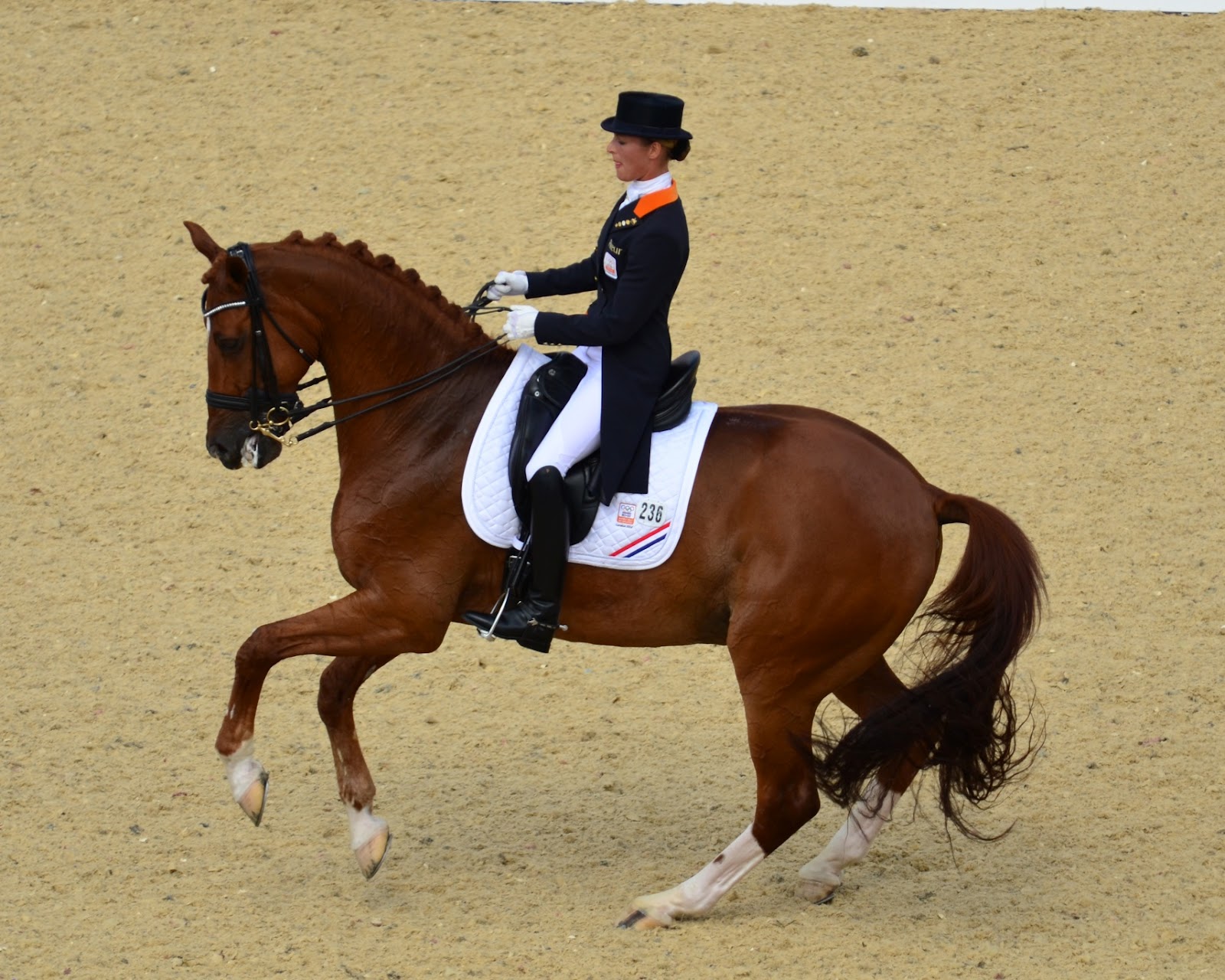
Individual silver medalists Adelinde Cornelissen and Parzival of the Netherlands. Photo by Jennifer Bryant.
Finishing a close second for the individual silver medal was the Netherlands' Adelinde Cornelissen on Parzival. Showing great musicality to pleasantly amped-up versions of The Nutcracker Suite, the Dutch pair earned marks of 92.286 (artistic) and 84.107 (technical) for a total score of 88.196 percent.

Parzival's piaffe to the "Dance of the Sugar Plum Fairy" was a highlight of Cornelissen's freestyle, as was his extended canter to the "Russian Dance." The routine featured numerous double pirouettes, clearly one of Parzival's strong suits. The fifteen-year-old Dutch Warmblood gelding (by Jazz) was short in the neck at times in the extended trot, and later piaffes started to get a bit croup-high.

Stephen Clarke, who served as president of the ground jury today, said of the rides: "I think the first two horses were very close. The impression we had was that Adelinde had huge power and expression, but for us there needed to be a little more lightness and self-carriage. You could see sometimes that the horse crosses his jaw a little bit, so that took down the harmony mark a touch.

"Charlotte's [horse] generally has a little more self-carriage but maybe not quite as much power and expression in some of the piaffe-passage," Clarke continued. "So they were very close together. I'm sure lots of people will have different opinions, but our decision was for the harmony."

Of her ride, Cornelissen said: "Parzival felt great. I think it has been one of his best tests ever. I gave it all."
Great Britain's Laura Bechtolsheimer exults after her bronze-medal-winning ride aboard Mistral Hojris. Photo by Jennifer Bryant.
Dujardin's gold-medal teammate Laura Bechtolsheimer and her longtime partner, Mistral Hojris, had a lovely interpretation of music from The Lion King. "Alf's" movement harmonized well with the music, including a passage half-pass to a piaffe pirouette that was right on the beat, and a piaffe-passage tour that showed great musical interpretation. Alf's movement looked a bit flatter than in the Grand Prix Special, but Bechtolsheimer was exuberant at the conclusion of her performance, which earned a technical score of 80.679 and an artistic score of 88.000 for a combined total of 84.339 percent and the individual bronze medal.

"Today I wanted to do him justice," Bechtolsheimer said, referring to the little mistakes of her previous tests at the 2012 Olympic Games. "I wanted to go out and enjoy the atmosphere and enjoy riding to an awesome freestyle in front of so many spectators and fans. He rose to the occasion. He gave me a very special ride. I felt like finally I'd done him justice."
Anky van Grunsven thanks Salinero for a job well done. Photo by Jennifer Bryant.
The previous Olympic individual champion, the Netherlands' Anky van Grunsven on Salinero, ended the eighteen-year-old Hanoverian gelding's (by Salieri) competitive career on a high note. Salinero gave his best performance of these Olympics, and in fact it's the best I've ever seen him look. He showed greater softness over his topline and relaxation to a French-themed medley that showcased van Grunsven's famous freestyle artistry. The freestyle was so good that I wouldn't have been surprised if she had medaled. The ride scored 77.714 (technical) and 86.286 (artistic) for a combined score of 82.000--and I actually thought it might have deserved a tick higher.

"I am not sad. It has been an emotional week, but it was always in my head that it was my last time, and I wanted to enjoy it," van Grunsven said afterward.
You can tell everything you need to know about how Steffen Peters felt about his GP Freestyle on Ravel by the expression on his face. Photo by Jennifer Bryant.
The other emotional ride of the day, unfortunately not in a good way, was that of the lone American rider to qualify for the Grand Prix Freestyle. Steffen Peters and Ravel's ride to music from the movie Avatar was artistically compelling but riddled with minor mistakes. Supporters, including Peters' wife, Shannon, teared up watching the ride, which Peters acknowledged afterward was indeed Ravel's competitive swan song.

"We did a super warm-up," Peters said of the freestyle. "We can't blame the heat; we are used to that, and I had plenty of horse. There were just too many mistakes. That is it for Ravel. He is retiring now to his owner's [Akiko Yamazaki] stud in California. I will remember him for his great career. If you put it all together, today was only a glitch. He has given us so much, and it is so sad, but it was not quite happening today."

Endings are always a little sad. The 2012 London Olympic Games have been a thrilling and memorable experience. The organizers did a superb job, and the Greenwich Park venue received accolades from every rider, veterinarian, and official I talked to. Over the past fourteen days we've seen outstanding displays of horsemanship, and we've seen the sport of dressage lifted to new standards. I will go home with memories of the friendly and welcoming staffers and volunteers and the hospitable locals, who seemed to enjoy sharing Greenwich and London with us. But I will also go home feeling sad for the American riders and their wonderful horses, owners, and supporters who worked so hard and yet will go home empty-handed.

Medals aren't everything, but at this level they are of course what competitors are striving for. Teams and individuals want to bring home medals to make their nations and their supporters proud. I know that Steffen Peters in particular is having a bittersweet evening, for this is not how he wanted to end Ravel's career. But I think I speak for the American dressage community when I say that we are proud, we appreciate Ravel's incredible legacy to US dressage, and we look forward to seeing Steffen doing great things in the future. He is a great rider and a great horseman, and his own legacy, although secure, is far from over.


Monday, August 6, 2012

Dressage Team Final Tomorrow!

Today my time is going to be devoted to the jumping team final (have you been following the competition? What a thrilling ending this is going to be!). Before I get too involved, I wanted to share with you the order of go for tomorrow's Olympic Grand Prix Special, aka the dressage team final. It all begins Tuesday at 10:00 a.m. London time.

If a rider is an individual (i.e., not competing for a team medal), I've put an (I) after the listing. Teams consist of three horse-rider combinations.

10:00 Anabel Balkenhol/Dablino (GER) (I)
10:09 Jessica Michel/Riwera (FRA) (I)
10:18 Mikaela Lindh/Mas Guapo (FIN) (I)
10:27 Patrick van der Meer/Uzzo (NED)
10:36 Emma Kanerva/Spirit (FIN) (I)
10:45 Jan Ebeling/Rafalca (USA)
10:54 Jose Daniel Martin Dockx/Grandioso (ESP)
11:03 Minna Telde/Santana (SWE)

11:25 Tina Konyot/Calecto V (USA)
11:34 Morgan Barbancon Mestres/Painted Black (ESP)
11:43 Tinne Vilhelmson Silfven/Don Auriello (SWE)
11:52 Steffen Peters/Ravel (USA)
12:01 Juan Manuel Munoz Diaz/Fuego (ESP)
12:10 Patrik Kittel/Scandic (SWE)
12:19 Ashley Holzer/Breaking Dawn (CAN) (I)
12:28 Victoria Max-Theurer/Augustin (AUT) (I)

1:45 Richard Davison/Artemis (GBR) (I)
1:54 Valentina Truppa/Eremo del Castegno (ITA) (I)
2:03 Goncalo Carvalho/Rubi (POR) (I)
2:12 Claudia Fassaert/Donnerfee (BEL) (I)
2:21 Dorothee Schneider/Diva Royal (GER)
2:30 Carl Hester/Uthopia (GBR)
2:39 Anne van Olst/Clearwater (DEN)
2:48 Anky van Grunsven/Salinero (NED)

3:10 Kristina Sprehe/Desperados (GER)
3:19 Laura Bechtolsheimer/Mistral Hojris (GBR)
3:28 Anna Kasprzak/Donnperignon (DEN)
3:37 Edward Gal/Undercover (NED)
3:46 Helen Langehanenberg/Damon Hill (GER)
3:55 Charlotte Dujardin/Valegro (GBR)
4:04 Nathalie zu Sayn-Wittgenstein/Digby (DEN)
4:13 Adelinde Cornelissen/Parzival (NED)

I don't know about you, but I can't wait!

Friday, August 3, 2012

Team USA Dressage Will Advance to the Grand Prix Special

Ravel's passage earned some of the highest marks for Steffen Peters and the US dressage team. Photo by Jennifer Bryant.
Steffen Peters' overall average Grand Prix score of 77.705 percent aboard Ravel boosted the American team's Grand Prix average to 72.801 percent, good enough for fifth place in the team standings.

The top seven teams advance to the Olympic Grand Prix Special; so Team USA will go forward to vie for an Olympic team dressage medal on Tuesday, August 7.

In the supple, relaxed, expressive style that we've come to expect from Ravel, the fourteen-year-old KWPN gelding (by Contango) put in an excellent Grand Prix test that earned raves from Peters.


"I am so excited. Ravel felt as supple as he has ever done. There were so many highlights that I can't wait for the next three days. I looked at Carl Hester's test [aboard Uthopia yesterday] and thought I might be similar, so my score is a thrill," Peters said afterward.


Peters was right: His 77.705 is just 0.15 percent behind Hester's 77.720. Hester currently lies in fifth place individually, and Peters lies sixth.


Leading the pack and helping to propel Great Britain to the top spot in the team standings is Charlotte Dujardin and Valegro, a ten-year-old KWPN gelding by Negro. Their score of 83.663 percent topped that of the Netherlands' Adelinde Cornelissen and the 1997 KWPN gelding Parzival (Jazz), who are second in the individual standings with 81.687 percent. Helen Langehanenberg and the 1999 Westfalen stallion Damon Hill (Donnerhall) of Germany are ranked third with 81.140 percent, and German teammate Kristina Sprehe on the 2000 Hanoverian stallion Desperados (De Niro) stand fourth with 79.119.
A "10" extended trot: Great Britain's Valegro and Charlotte Dujardin. Photo by Jennifer Bryant.


The seven-judge panel (Gary Rockwell of the USA at C, Leif Tornblad of Denmark at H, Stephen Clarke of Great Britain at M, Maribel Alonso of Mexico at B, Evi Eisenhardt of Germany at F, Wim Ernes of the Netherlands at K, and Jean-Michel Roudier of France at E) awarded Dujardin and Valegro particularly high marks for their extended trot and their two-tempi changes. The two-tempis earned four scores of 10, and their second extended trot earned three 10s. In the collective marks, Dujardin received two 10s for "rider's position and seat; correctness and effect of the aids."


Dujardin called Valegro's score, which set a new Olympic Grand Prix record, "unbelievable. I wanted to come here and have fun. I wanted to go out and show what this horse can do. It is a once-in-a lifetime-opportunity."


As the judges saw it, Parzival's highlights were his piaffe (one 10) and his passage and piaffe-passage transitions (several scores of 9.5). Cornelissen received one 10 for the "rider" collective mark.


There were no marks of 10 for Peters and Ravel. Ravel got some 9s for his extended canter, canter pirouettes, and passage; but he also earned across-the-board scores of 5 for movement 25, the flying change at X between the two pirouettes, which appeared to be late behind.


The first to go today, the USA's Tina Konyot on her Danish Warmblood stallion Calecto V (by Come Back II), put in a solid and fluent test with a few minor bobbles to score 70.456 percent. They are currently twenty-seventh individually.
Tina Konyot embraces Calecto V after their Grand Prix test. Photo by Jennifer Bryant.
"I missed a couple of my extensions in there, but overall I was very happy with my test," Konyot said. "It's just a great feeling to be here."


Despite the fact that the audience wasn't yet quite settled by the time Konyot entered the arena, the rider claimed it wasn't a distraction.


"I'm in my own zone," she said. "Someone could streak across the arena and I wouldn't notice them--well, it depends on who it is," she added.


US individual competitor Adrienne Lyle kept the occasionally explosive Wizard mostly focused and relaxed to produce a promising test that earned a score of 69.468 percent, putting them thirty-fifth in the individual standings.
Adrienne Lyle and Wizard in a lovely canter pirouette. Photo by Jennifer Bryant.


"Wizard was very amped up and on the edge, so we were trying to hold it together so he didn't get too flustered," Lyle said afterward. "He had a few mistakes just due to tension [including a break to canter during an extended trot], but I was happy."


Lyle said the 1999 Oldenburg gelding (by Weltmeyer) was pretty excited just before the pair's entrance into the Olympic equestrian stadium.


"We weren't even able to walk into the ring," she said. "We were kind of doing whirlybirds."


Lyle is thoroughly enjoying her first Olympic experience. "It was very cool going down center line, for sure!" she said. 


US team pair Jan Ebeling and Rafalca, who competed yesterday, are in thirtieth place individually with their Grand Prix score of 70.243 percent.


Besides Great Britain, Germany, and the USA, the other teams that will advance to the Grand Prix Special (the team medal final) are the Netherlands (3), Denmark (4), Spain (6), and Sweden (7). 


It will be exciting to see what the competition ahead brings. The bar has already been set in the low 80s; and later scores, especially those in the Grand Prix Freestyle, typically rise significantly. I wouldn't be surprised if we see some scores of 90-plus in the days to come.